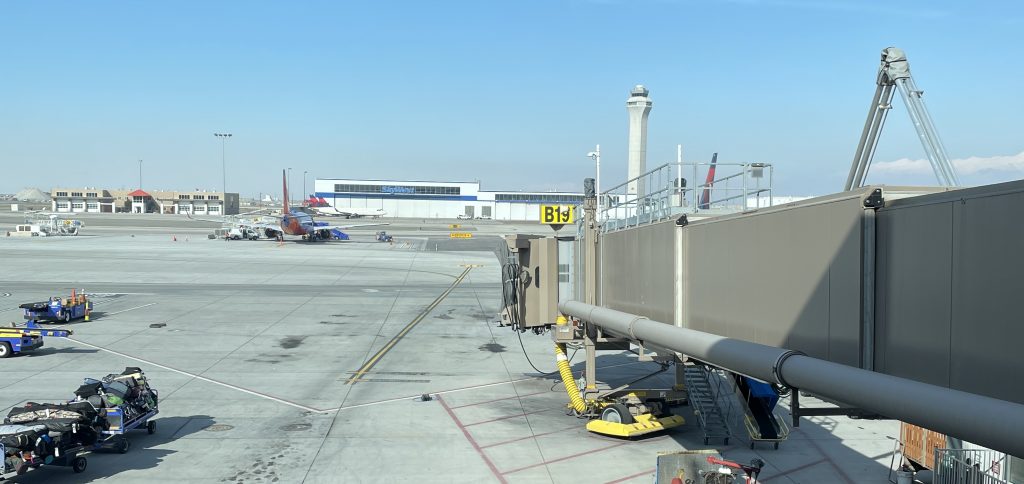
Culture at end of a jetbridge

the B19 jetbridge tunnel at SLC

Though it has been more than a decade since that landing at La Guardia airport, I distinctly remember the feeling of being on NYC streets or subway while still belted to my seat on the plane. The murmor and impatience that arose amongst us passengers was eerily similar to that experienced on the city’s streets in trips before.

I’ve sensed a similar feeling when landing at other airports and wondered if we somehow switch to a personality mimicking that of an arrival city, especially one we’ve visited before. And does that affect our behavior and mood when arriving at a new destination? I do believe this “feeling” is different than behavioral norms like the cowboy hats on flights enroute to Texas destinations, the alcohol-fueled party atmosphere enroute to Vegas, the Mickey Mouse ears on flights into Orlando. It is also different than the food experienced toward certain destinations such as Chicken tikka masala on British Airways into London or Salmon, rice and miso enroute to Japan.

This feeling became more pronounced for me over the past couple of years arriving at Salt Lake City. In a city heavily influenced by the prominent religion, the airport is often host to missionaries heading on their commitments or arriving back home. Beyond the missionaries though, there seems to be a respect and deferential component to visitors. I rarely see grumbling, anger, or shouting and observe general communal regard. A plane full of passengers remains seated just a bit longer awaiting their row’s turn to deplane.

A landing in Kuala Lumpur recently had its own unique feeling. Despite the late hour and a short shuttle flight, there was a hometown camaraderie. The return flight back to Singapore on the same discount airline was quite different and similar to other rushed urban destinations. I see similar hometown camaraderie arriving home in Des Moines where people magically find connection over weather, their employer, or the Hawkeyes. Arriving at Boston Logan one feels the presence of academics – from college logoed clothing to more passengers reading books and even professorial garb (leather arm patches on sport coats are dead ringers!)

I wonder what is it that prepares us so for what is about to meet us at the end of the jet bridge?

Is it fiction or real?

I have become a fan of near-real-time fiction through books addressing the startup communities. Eliot Peper got me started with his Uncommon Stock series and this book by Josh Riedel showed up in my Goodreads queue from Brad Feld, who incidentally had also turned me onto Eliot.

What happens if you report the bug which morphs reality into fantasy and science fiction

The book had an incredible start and picked up my interest considerably during the middle. A few pages in I actually had to double check to ensure this was fiction as it read so much like a memoir. The book feels non fiction in its beginning, as true life a story as possible. The life inside a startup, the type of work involved, the food, culture, working environment and more feel all too real. The real streets, restaurants, menu items and residences all reminiscent of a photograph that captures reality and not an abstract painting. This continued all the way past the M&A activity. The drama, intrigue, unresolved sexual tension, pain, sorrow, and desire throughout the middle feel like Ethan is simply telling what is happening to him – the writer and the protagonist.

The last third, however, enters the realm of fantasy and out of sci-fi and the dissonance lost me.  Though the transition is somewhat gradual, it still hit me as other-worldly. Once I shifted my own thinking and imagery to science fiction (or fantasy!), I was able to carry on toward the end.

Josh employs a technique to introduce human and (seemingly) inhuman characters and entities differently (I don’t know if this technique has a name – it surely must!). People and companies that are emotionless and irrelevant are simply called Corporation, Funder, Engineer. No soul, just a place in the author’s world. They interact with the humans, affect them and their emotions, control them and dispense with them. Yet, since we are never introduced to their ‘soul’, it is hard to love or hate them. Indifference is all that remains.

I read the final 50 or so pages in-flight, landing at Denver International in a cloak of darkness. An apt metaphor for the way the book itself happens, leaving me thinking as wheels touched ground — was it all just a dream? 

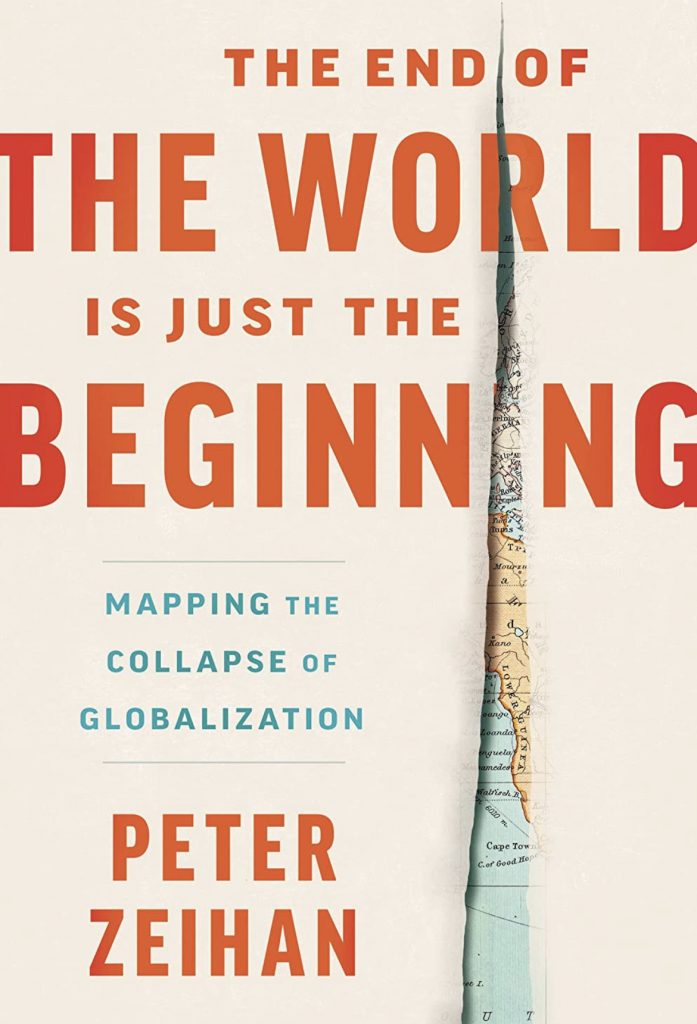
End of the world is just the beginning

My brief review of this large and fact filled book about our world

A nearly 500 page walk through the history of our world that gives one a view (and author’s perspective) on what is to come. It tackles transport, agriculture, manufacturing, energy, materials, finance in sufficient detail to understand nuances across various regions. 

My favorite part was the discussion of where certain items are sourced, purified, manufactured and finished covering iron through gold. 

I leave the book quite surprised at how remarkably little discussion occurred about the most populous country on earth – India. Peter is singularly focused on China and I wonder if his predictions would have been better informed with covering India and Canada a bit more. Or, perhaps in his eyes, the two countries are irrelevant to the past and future global order. 

All in all, a fun read that made me think hard about the world we inherited and inhabit.